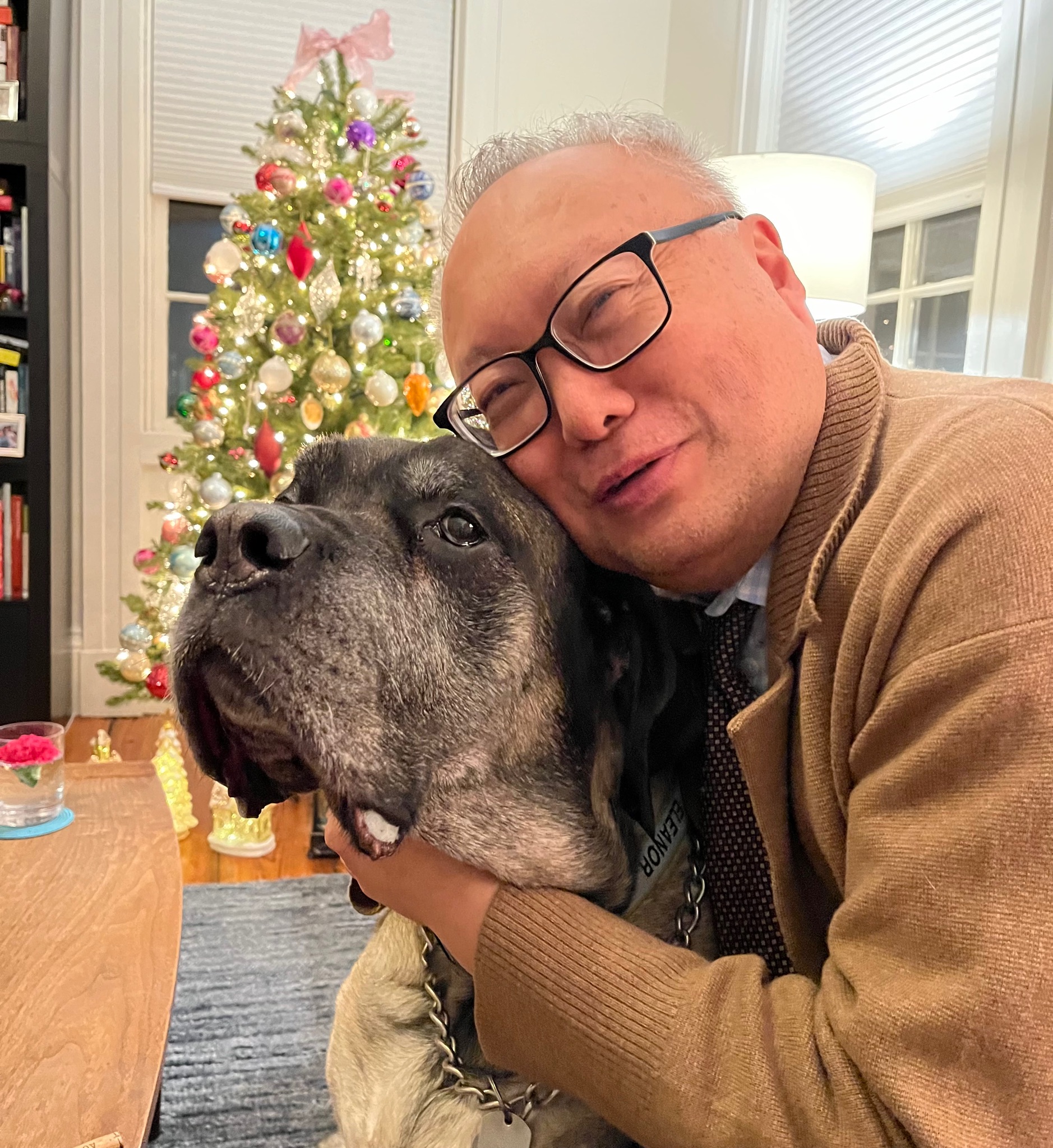
We lived two blocks away from each other. We were good friends before, but then came the dog.
At first, the dog was just an idea, a metaphor for the conjoinment of two entirely different households. For as long as we knew him, Eric – an out, gay, single man – would often talk about wanting a dog that was old and lazy, that was housebroken, low maintenance, and easy with the students. We (married with two children) already had a dog. Whenever Eric came over, our labrador, Brick, would sit happily at his side, pretending – in the way of dogs when the favored guest arrives – to belong to someone else. And Eric would look over at him and just say, with a deflated sigh, “I should get a dog.”
The dog would have to wait, we all knew, because “The Job” was overwhelming. Anyone who visited Eric could see that the mail piled up during busy months, and that large boxes were left unopened in the foyer. There was always a crisis, always another dinner with students, always a memo or a letter or an email that needed reading or writing, early in the morning, in between meetings, or late at night. So much of his life was held in abeyance by “The Job.”
Then, a dear friend passed away under sudden, tragic circumstances – and the metaphor of the dog became all too real. That friend had an older dog – a mammoth 150 lbs dog, housebroken and lazy. The dog had an antique, “old lady’s name,” as Eric would put it: Eleanor. She had the demeanor – a little nervous, a little suspicious, a little worried, a little weird – of a side character on the Golden Girls. Eleanor was a sympathetic type with a sentimental story of compounding tragedies: abused as a puppy, she had already been abandoned twice.
This dog had nowhere left to go.
On a whim, Sandi pitched the outrageous idea of a new partnership, a dog-share, with Eleanor moving back and forth between homes every day or so. Eric impulsively and enthusiastically said “Yes!” We all had to wait a few months for her to arrive, so he threw himself into the planning, ordering dog food and biscuits, orthopedic beds and floor mats. He bought a bigger car so that she might join him on the road. We set up an account at the vet, giving her a hyphenated last name. We took meetings to construct a theory of the collaboration, this co-parenting arrangement. Eric loved Eleanor before he even met her, but he also loved doing this together.
Humor abounds in what came next. Many of you will know that when she finally showed up in his backyard, she made him work for every second of affection. Her complicated, challenging past made her initially apprehensive, and the dog-sharing arrangement was – I’ll admit – unusual and probably somewhat confusing. We joked that she cannily sensed his eagerness, his desire to be loved. But that was all on Eleanor. For his part, Eric was prepared and determined, his commitment unconditional: there were no deferrals for Eleanor.
We unwound together most nights during what we called “the dog transfer.” Much of the time, we talked about Eleanor’s day, because she has a lot going on in her head. With Eleanor perpetually underfoot, we made – or perfected – cocktails, testing gimlets and aviations each night. We cooked together, the mashed potatoes at our place and the brisket at his, even when we were dining apart. The dog-transfer became something more, a moment to exchange food, a site to return tupperware, a switching point for canine medicine, an emotional space for reunion. It became a suture, not just a metaphor, and then it became even more. When Eleanor tore her knee and needed radical surgery to repair it, Eric slept on our floor to keep her company while she healed, sharing breakfast with our kids as they got ready for school. Over French toast, the three of them – Robert, Maya, and Eric – would talk about the melodramas of the day to come.
This all seems like it was a thousand years ago. Or like it was just this morning.
Shell-shocked and wandering through Eric’s house after his death, we learned that he had big, exciting plans. There were hundreds of photographs to be carefully mounted in albums or framed. There were new suits to be worn, new shoes, and a new bed for Eleanor. He was lining up dog-sitters so that he could return to P-town and Germany.
We had made some of those big plans together. The three of us were looking for a summer property to co-own, something with a sliver of a water view out the window. On weekends, we spelunked prospects and grabbed lunch, discussing how Eleanor might adapt to this layout or that redesign.
We started to think about life after Eleanor, too. Tentatively, we searched online for another dog, an appropriate companion for the great, gray lady. We started smaller, looking for photographs of more reasonably sized dogs with spunk, with a certain ungovernable look in their eye. I had a sabbatical coming up, our kids were both off to college, and we marked the summer as a perfect time to bring a new personality into this extended household.
Eric, of course, dreaded the idea of losing Eleanor.
Dogs don’t live forever, but the people who are lucky enough to live with them share a certain folklore. You want your old dog, the idea goes, to spend some time with the new dog, so the new dog can learn some things, and so that you can see patterns of behavior, good or bad, that remind you of an animal you once loved who is now gone. The new dog twists their head in a certain way, or sleeps in a particular place, and it triggers a flood of memories.
This comforting bit of folklore, I’m certain, is really about loss, and not just about dogs. The story I’ve shared here, I’m equally certain, isn’t really about Eleanor. She just happens to be the perfect symbol for the complicated, abundant, transgressive, and queer commitments of love and belonging that animated Eric’s life, and that bring us all here today. “Found family” and “chosen family,” “dog-shares” and “co-parenting,” all words we use to explain the inexplicable. Words that were, for all of us, hollowed out on June 4, the day he died.
But that folklore about what new dogs learn from old dogs is also sort of why we’re all here today. We call out those details – quirks, distinctions, gifts, and failures – that we owe to Eric. We see his gestures and hear his echoes everywhere and hold them close.
Sandi and I spent this summer saying goodbye over and over again. The weight of sorrow, though, is easier to bear in company. Through the sharing of grief we have discovered dozens of smaller, intimate circles just like ours, through which he welcomed a new kind of relationship, leaping to share, to join, to become a part of another new, unusual, sprawling thing. “Yes!” seems to have been Eric’s favorite word, and it allowed him to embrace a moment or a chance.
Some days, on the street, people come up to ask about Eleanor, introducing themselves as someone she loves. She revels in the celebrity – and in seeing old friends. Some nights, looking around our kitchen, we find ourselves amazed by the bigger family we now routinely discover in spaces once inhabited by Eric, supporting our kids, searching for dessert in the freezer, asking for a specific cocktail, or casually conversing with Eleanor as if she were human. In these moments of heartbreaking clarity, we see Eric in every face. We catch his tone in every kindness.
I hope you see it, too. I hope, for all of us, that the next hour, or month, or year is spent celebrating these moments of startling recollection, when we understand what we carry forward. Celebrating the moments when we agree to hold misery together, to sustain its binding emotional power and also to make it bearably lighter. And celebrating those moments when we refuse to defer what will surely bring us indescribable pleasure and contentment.
[The remarks were delivered at the Celebration of Life for Eric Estes on September 13, 2024. Eric passed away on June 4].
 MPG
MPG 